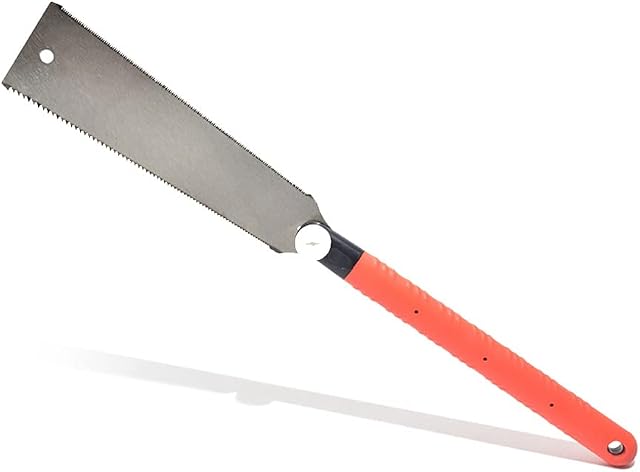
Stanley 217202 14-inch 350mm FatMax Tenon/ Back Saw 13tpi by Amazon.co.uk
- • Reinforced back for extra rigidity makes a straighter cut
- • Handle screwed to blade for extra strength
- • Bi-material handle for improved grip and comfort
- • Triple edged teeth cut
- • Induction hardened teeth
Description
Choosing the right saw depends on the size and type of saw teeth, which is appropriate for the task. The tooth size is indicated by the number of full teeth per inch (Tpi = teeth per inch). Large and few teeth give a faster cut. A larger number of smaller teeth gives a fine cut. The following overview shows you which teeth are best suited for your needs.
Construction.
Areas of use: General construction work, carpentry, standwork, beams, planks, coarse cutting. Teeth: Coarse teeth, 7 teeth per inch.
Finishing
Areas of use: Frames, wall and ceiling cladding, floor coverings, laminate and parquet, PVC, fine teeth. 11 teeth per inch.
Special tasks.
Areas of use: Floor coverings, PVC and plastic pipes, plasterboard and drywall elements, aerated concrete. Special saws: With different teeth and tooth sizes for specific tasks
Tips and techniques from the professional.
Step 1:
You can achieve a good cut without tearing out by marking the line with a knife, not with a pencil. Always saw on the bad side (cut side). If you are unsure, leave some space. If necessary, protruding wood can be planed subsequently flat.
Align the good side upwards so that splinters or torn areas are covered at the bottom. This is particularly important when working on ceiling or floor coverings, such as laminate.
Step 2:
Start cutting at the edge farthest away from you. Hold the saw at an angle of approx. 30° to the surface. Use the thumb nail of your free hand or a remnant piece to position the cut to the bad side. The first stroke should be more like a light pull to create the cut line (notch).
If the saw is correctly in the notch, continue to saw at an angle between 45° and 60° to the surface.
Step 3:
Hold the handle firmly but relaxed. Keep your wrist, elbow and shoulder in line with the saw blade and marked line. You should also keep your head and eyes in line with the cut.
Use the whole length of the saw with constant, non-rushing movements. The speed can be increased by lowering the handle once the blade has slipped half through the material on impact. Lower the handle when pulling. Slow down the pace when the saw leaves the marked line. Correct your standing position and carefully try to restore the mark.
The saw sound shows you the end of the cut. Support the sawn piece of wood so that it does not fall off uncontrollably.
Product information
- Brand:Stanley
- Colour:Multi-coloured
- Surface recommendation:Wood
- Power source:AC
- Included components:FatMax® Tenon Back Saw 360mm (14in) 13 TPI
- Manufacturer:Stanley Black & Decker
- Part Number:2-17-202
- Product Dimensions:18.5 x 4.33 x 1.38 cm; 490 Grams
- Item model number:2-17-202
- Size:14 Inch (350 mm)
- Power Source:AC
- Voltage:28 Volts
- Item Package Quantity:1
- Included Components:FatMax® Tenon Back Saw 360mm (14in) 13 TPI
- Batteries included?:No
- Batteries Required?:No
- Item Weight:490 g
Related products to Stanley 217202 14-inch 350mm FatMax Tenon/ Back Saw 13tpi:



Explore other categories
Other products from Handsaws: